First-Time Home Buyer Programs in Calgary: A 2026 Guide

First-Time Home Buyer Programs in Calgary: A 2026 Guide
Buying your first home in Calgary is exciting but figuring out all of the programs, tax credits, savings accounts and down payment rules available to first-time buyers can feel like learning another language.
FHSA. HBP. RRSP. GST rebates. Mortgage insurance.
What do you actually qualify for, and which programs can you use together?
The good news is that there are several programs available in 2026 that can make buying your first home more affordable. Some can help you build your down payment, some provide tax benefits, and one newer program could significantly reduce the GST paid on an eligible new home.
Here's what Calgary first-time home buyers should know.
Quick note: Programs and eligibility rules can change, and everyone's financial situation is different. This guide is intended as a starting point rather than financial or tax advice. Before making financial decisions, confirm your eligibility with the CRA, your lender, mortgage professional or financial advisor.
What Counts as a First-Time Home Buyer?
This is one of the first misconceptions worth clearing up.
Being a “first-time home buyer” doesn't always mean you've never owned a home in your life.
Different programs have slightly different eligibility rules, but many federal programs use a look-back period involving the current calendar year and previous four calendar years.
For example, the FHSA rules generally look at whether you lived in a qualifying home that you or your spouse/common-law partner owned during the applicable period. The exact definition can also differ depending on whether you're opening an FHSA or making a qualifying withdrawal.
So if you've owned before but have been renting for several years, don't automatically assume you aren't eligible.
1. First Home Savings Account (FHSA)
For many first-time buyers, the First Home Savings Account is one of the first programs worth learning about.
An FHSA essentially combines some of the benefits we associate with an RRSP and a TFSA.
You can contribute based on your available FHSA participation room, with an $8,000 annual limit and $40,000 lifetime contribution limit. Eligible contributions can be deducted from your taxable income, while qualifying withdrawals used to purchase a home are tax-free and do not need to be repaid.
One thing future buyers should know
Your FHSA participation room doesn't simply accumulate indefinitely because you could have opened an account.
In the first year you actually open your FHSA, your participation room is generally $8,000.
So even if buying a Calgary home is still a couple of years away, this is something worth discussing with your financial advisor sooner rather than later.
2. Home Buyers' Plan (HBP)
The Home Buyers' Plan is another option for eligible buyers who have money saved in an RRSP.
The HBP currently allows an eligible buyer to withdraw up to $60,000 from their RRSP toward buying or building a qualifying home.
If two eligible buyers are purchasing together and each qualifies, each can potentially access funds from their respective RRSPs.
Unlike a qualifying FHSA withdrawal, however, HBP withdrawals generally have to be repaid.
There's also an important temporary rule for buyers purchasing now: for people making their first HBP withdrawal between January 1, 2026 and December 31, 2028, the start of the 15-year repayment period is deferred until the fifth year following the withdrawal year.
That makes it especially important to check the current rules rather than relying on an older first-time buyer article you find online.
3. Can You Use an FHSA and the Home Buyers' Plan Together?
Yes.
This is one of the most useful things for first-time buyers to understand.
If you meet the requirements for both programs, the CRA allows you to make a qualifying FHSA withdrawal and an HBP withdrawal for the same qualifying home.
That doesn't mean everyone should automatically empty both accounts. Your down payment strategy should make sense for your broader financial situation.
But knowing the programs can work together gives buyers another option when planning for a purchase.
4. The Home Buyers' Amount
There's also a federal tax credit that sometimes gets overlooked.
Eligible buyers can currently claim up to $10,000 as the Home Buyers' Amount on their federal tax return for a qualifying home. It is a non-refundable tax credit, meaning it reduces federal income tax owing rather than functioning like a cash grant.
If more than one eligible person purchases the same property, the amount can be divided between them, but the combined claim cannot exceed the maximum allowed for that home.
That's an important distinction because you'll sometimes see this described online as though each buyer receives a separate full credit.
5. NEW: First-Time Home Buyers' GST Rebate
This one is particularly interesting for Calgary buyers considering new construction.
The federal First-Time Home Buyers' GST/HST Rebate is now available.
Eligible first-time buyers purchasing, building or substantially renovating a qualifying home may be able to recover up to 100% of the GST paid, to a maximum rebate of $50,000, on homes valued at or below $1 million.
For eligible homes between $1 million and $1.5 million, the maximum rebate is gradually reduced. At $1.5 million or above, the rebate is no longer available.
This isn't for a typical resale home. It's aimed at qualifying newly built or substantially renovated homes, and there are specific eligibility and timing requirements. For a home purchased from a builder, qualifying agreements generally need to have been entered into on or after March 20, 2025 and before 2031.
Why this matters in Calgary
With the amount of new construction happening throughout Calgary and surrounding communities, this is a program I would absolutely want first-time buyers to know exists before purchasing a new build.
Depending on the home and your eligibility, we're no longer talking about saving a few hundred dollars.
We're potentially talking about tens of thousands of dollars.
6. How Much Down Payment Does a First-Time Buyer Need in Calgary?
Being a first-time buyer doesn't mean you automatically need a 20% down payment.
For an eligible insured mortgage, current minimum down payment requirements are:
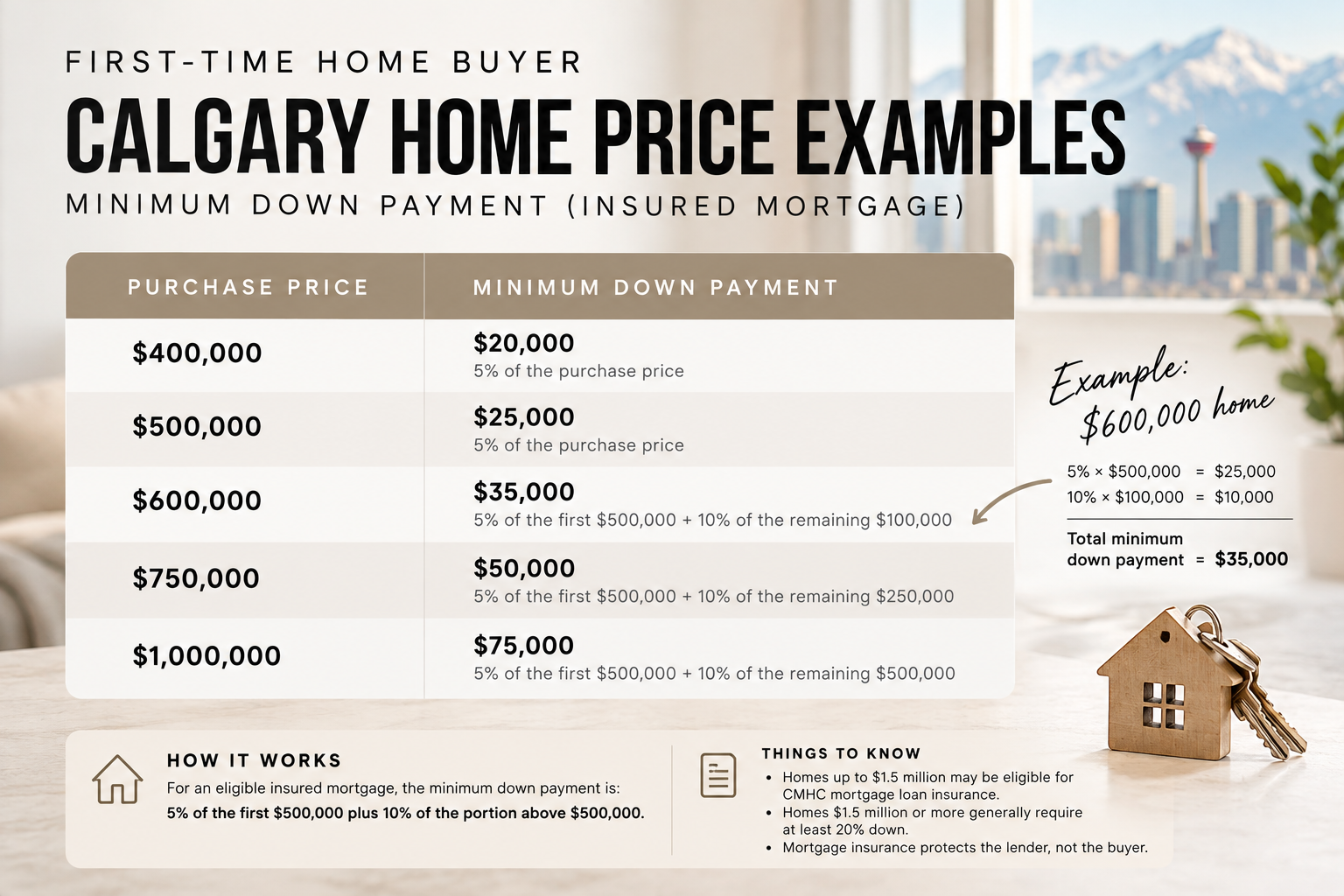
The calculation is 5% of the first $500,000 plus 10% of the portion above $500,000. Homes at $1.5 million or more aren't eligible for CMHC mortgage loan insurance and generally require at least 20% down.
What happens if you put down less than 20%?
Generally, you'll need mortgage loan insurance.
The insurance protects the lender, not the buyer, and the premium is typically added to the mortgage or paid at purchase. The premium varies depending on factors including the loan-to-value ratio.
That doesn't automatically mean putting less than 20% down is a bad decision.
Sometimes getting into the right home while maintaining some cash reserves makes more sense than draining every account simply to reach a particular down payment percentage.
That's a conversation to have with your mortgage professional based on your finances.
7. Are There First-Time Home Buyer Grants in Alberta?
This is where Google can get confusing.
Search “first-time home buyer grants Canada” and you'll find articles talking about provincial land transfer tax rebates, municipal grants and other programs.
The problem is that many of those programs are province- or city-specific.
A program available to someone buying in Ontario or another province doesn't automatically apply to someone buying in Calgary.
That's why I prefer looking at the actual programs available to you rather than building your purchase around a generic list of “Canadian home buyer grants.”
For Calgary buyers, the federal programs above are an excellent starting point. From there, your mortgage professional, financial advisor and REALTOR® can help identify whether any additional programs apply to your particular purchase.
8. Don't Spend Every Dollar on Your Down Payment
This is one of the biggest things I want first-time buyers to think about.
Getting the keys isn't the end of the expense.
Depending on the property, you may also have:
- legal fees and title-related costs
- home inspection costs
- property tax adjustments
- home insurance
- moving expenses
- condo document review if you're buying a condo
- utility setup
- furniture, appliances or immediate repairs
- an emergency fund for the inevitable “Oh cool, apparently I own a furnace now” moment 😂
Putting every available dollar into your down payment can leave you house-rich and cash-poor very quickly.
I'd rather see buyers understand their total cost of ownership before we start looking at houses.
So, What's the Best First Step?
Before worrying about which house to buy, figure out what buying comfortably actually looks like for you.
That means understanding your mortgage qualification, available down payment, potential FHSA or HBP funds, closing costs, monthly expenses and any programs you may qualify for.
Once you know those numbers, house hunting becomes a lot less overwhelming.
Frequently Asked Questions
How much can I withdraw from my RRSP as a first-time home buyer?
The current Home Buyers' Plan withdrawal limit is $60,000 per eligible individual.
Can I use an FHSA and RRSP Home Buyers' Plan together?
Yes. If you meet the eligibility requirements for both, the CRA allows an HBP withdrawal and qualifying FHSA withdrawal toward the same qualifying home.
How much can I contribute to an FHSA?
Your participation room depends on your circumstances, but the annual FHSA limit is generally $8,000, subject to available room, with a $40,000 lifetime contribution limit.
Is there a first-time home buyer GST rebate in Canada?
Yes. As of 2026, eligible first-time buyers may qualify for the new federal GST/HST rebate on a newly built or substantially renovated home. It can rebate up to 100% of the GST on qualifying homes valued at $1 million or less, to a maximum of $50,000, with a reduced rebate available between $1 million and $1.5 million.
Do first-time buyers need 20% down in Calgary?
No. Eligible buyers may purchase with less than 20% down, although mortgage loan insurance will generally be required. For homes up to $500,000, the insured-mortgage minimum is 5%; above $500,000, it's 5% of the first $500,000 plus 10% of the remaining portion, up to the insured-mortgage price limit.
Buying Your First Home in Calgary?
Buying your first home can feel like learning an entirely new language — mortgages, conditions, inspections, closing costs, FHSAs, RRSPs... it's a lot.
That's exactly why I created my First-Time Home Buyer Workshop.
I walk you through the Calgary buying process from getting prepared financially to getting the keys, so you understand what to expect before you're standing in a house wondering whether you should write an offer.
Recent Posts